Tuesday, April 23, 2019

Days 29 - Psychological Disorders - Quiz

Learning Targets - Students will be able to 
  • Describe and analyze common symptoms, causes, and treatments for frequently diagnosed psychological disorders 
Opener YOU HAVE 2 MINUTES TO grab your notebook and pick up an answer sheet.


Activity #1 - Quiz

Your quiz will consist of 19 multiple choice items based on scenarios/case studies.  You will be asked to identify the correct disorder and address other symptoms, treatment options, etc.


Activity #2 - Scenario/Case Study Review

Each student will have an opportunity to review each scenario presented in the quiz for clarification, feedback, etc.

Activity #3 - Final Intro

Your final will be a cumulative examination of this year's content.  It will consist of multiple choice, short answer, and one essay question.  You are strongly encouraged to have your notebook on this day.  Also, remember that every lesson since the first day is available here on the website.

For seniors, this will be on the 29th of April.


Close - Post at least 2 questions here:

MAKE SURE THAT YOU CLICK THE APPROPRIATE TAB AT THE BOTTOM OF THE PAGE

Tuesday, April 16, 2019

Days 26-29 - Psychological Disorders - Group Project

Learning Targets - Students will be able to 
  • Describe and analyze common symptoms, causes, and treatments for frequently diagnosed psychological disorders 
Opener You have 5 minutes to find your partner, share whatever visual aids/presentation that you want on the screen, and be ready to present.

A card will be drawn and that group will have 7-12 minutes to present their findings.

A's -Antisocial Personality Disorder
K's - Borderline Personality Disorder
Q's - Dependent Personality Disorder
J's - Histrionic Personality Disorder
10's - Narcissistic Personality Disorder
9's - Paranoid Personality Disorder
8's - Dissociative Identity Disorder
7's - Hoarding Disorder
6's - Kleptomania
5's - Trichotillomania


Activity #1 - Presentations

Audience Requirement:
  • Summarize the disorder being presented, common symptoms, and at least one treatment option.  Test questions for the final will be drawn directly from the presentations.
  • Be polite, respectful, and willing to ask questions or for clarification.
Presenter Requirements and Scoring:
  • Presentations will be capped at 12 minutes to ensure that all presenters have a chance to present.
  • If a member of your group is absent you will have an additional 5 minutes to modify or alter your presentation, but you will still present.  Fair considerations regarding scoring will be made.
  • Remember that you are the SME for this exercise.  
Required Data and Information
  1. Introduction via case study - 3 pts
  2. History of diagnosis, research, and treatment - 5 pts
  3. Recent research and treatment - 8 pts
    • Diagnosis and tests
    • Risk factors and causation
    • Top 3 most common treatment options
      • Summary, description, limits/dangers
    • Prevalence and recent research/discoveries
  4. 2nd Case study - 3 pts
  5. Related issues - 1 pt
  6. Where to go for more information - 2 pts
Close - Post at least 2 questions here:

MAKE SURE THAT YOU CLICK THE APPROPRIATE TAB AT THE BOTTOM OF THE PAGE

Tuesday, April 9, 2019

Days 26-29 - Psychological Disorders - Group Project

Learning Targets - Students will be able to 
  • Describe and analyze common symptoms, causes, and treatments for frequently diagnosed psychological disorders 
Opener - Find your 4 of a kind group and reference the list below for your group's assigned corresponding psychological disorder below:


A's -Antisocial Personality Disorder
K's - Borderline Personality Disorder
Q's - Dependent Personality Disorder
J's - Histrionic Personality Disorder
10's - Narcissistic Personality Disorder
9's - Paranoid Personality Disorder
8's - Dissociative Identity Disorder
7's - Hoarding Disorder
6's - Kleptomania
5's - Trichotillomania


Activity #1 - Psychological Disorders Group Project

Project guidelines

Below are the broad requirements for the upcoming group project that focus on some of the most serious and fascinating disorders.  

Required Data and Information

  1. Introduction via case study - 3 pts
  2. History of diagnosis, research, and treatment - 5 pts
  3. Recent research and treatment - 8 pts
    • Diagnosis and tests
    • Risk factors and causation
    • Top 3 most common treatment options
      • Summary, description, limits/dangers
    • Prevalence and recent research/discoveries
  4. 2nd Case study - 3 pts
  5. Related issues - 1 pt
  6. Where to go for more information - 2 pts

Product/Outcome

  1. Presentation
    • 7-12 minutes
    • Must include proper citations and clear formatting
    • Each member must record their daily contributions in their notebook

Activity #2 - Daily benchmarks
Each class period will have set benchmarks for project completion

Today's Benchmarks
  1. You will have 10 minutes to meet with your group to discuss how you wish to divide up responsibilities, create the presentation, and collaborate on shared pieces.
  2. Each student should be able to explain their specific duties regarding the project
  3. History of the disorder should be complete prior to exiting class today


Close - Post at least 2 questions here:

MAKE SURE THAT YOU CLICK THE APPROPRIATE TAB AT THE BOTTOM OF THE PAGE

Friday, April 5, 2019

Days 24-25 - Psychological Disorders - Introduction

Learning Targets - Students will be able to 
  • Describe and analyze common symptoms, causes, and treatments for frequently diagnosed psychological disorders 
Opener For each, indicate whether you think the behavior is or is not a psychological disorder. If you’re not sure, what other information would you need to know to be more certain of your diagnosis?

Activity #1 - Psychological Disorders - Challenges in diagnosis
  • Distress and disfunction


  • Is it debilitating?


  • Similarity or overlap in symptoms


  • Comorbidity occurs when people who suffer from one disorder also suffer at the same time from other disorders
    • Because many psychological disorders are comorbid, most severe mental disorders are concentrated in a small group of people (about 6% of the population) who have more than three of them (Kessler, Chiu, Demler, & Walters, 2005).
  • Stigma a disgrace or defect that indicates that person belongs to a culturally devalued social group
    • In some cases the stigma of mental illness is accompanied by the use of disrespectful and dehumanizing labels, including names such as crazy, nuts, mental, schizo, and lunatic.
    • The most significant problem of the stigmatization of those with psychological disorder is that it slows their recovery. People with mental problems internalize societal attitudes about mental illness, often becoming so embarrassed or ashamed that they conceal their difficulties and fail to seek treatment. 
    • Stigma leads to lowered self-esteem, increased isolation, and hopelessness, and it may negatively influence the individual’s family and professional life (Hayward & Bright, 1997).
  • Diagnostic and Statistical Manual of Mental Disorders (DSM), a document that provides a common language and standard criteria for the classification of mental disorders (American Psychiatric Association, 2013). 
    • The DSM is used by therapists, researchers, drug companies, health insurance companies, and policymakers in Canada and the United States to determine what services are appropriately provided for treating patients with given symptoms.

Activity #2 - Is the DSM legit?

After reading the brief articles linked below, address each of the following:

1.  What is the most valuable idea or concept discussed in either of the articles?
2.  How might this information be useful for most people?
3.  Identify one point in which you would question or disagree with the author.
4.  Write two questions that you would ask the author if he/she was here.


https://www.psychologytoday.com/us/blog/witness/201305/dsm-5-much-ado-about-nothing-part-i-ii

Close - Post at least 2 questions here:

MAKE SURE THAT YOU CLICK THE APPROPRIATE TAB AT THE BOTTOM OF THE PAGE

Tuesday, April 2, 2019

Days 24-25 - Psychological Disorders - Introduction

Learning Targets - Students will be able to 
  • Describe and analyze common symptoms, causes, and treatments for frequently diagnosed psychological disorders 
Opener - Introductory Reading - When minor imperfections lead to unthinkable consequences

Read through the brief case study found below and think about the following questions:

https://docs.google.com/document/d/1iqU-u_fY8ytT8WJN0RrnP8sUpe209NiG4YK-4fF0WW8/edit?usp=sharing
  1. What do you think might cause people like Robert to become so sensitive about their appearance?
  2. Aside from our physical appearance, what other aspects of our lives do you think people are commonly sensitive about?
Activity #1 - Psychological Disorders - Introduction Mini-Lecture


Abnormal psychology — the application of psychological science to understanding and treating mental disorders — is appropriate, as more psychologists are involved in the diagnosis and treatment of psychological disorder than in any other endeavor, and these are probably the most important tasks psychologists face.

  • The impact of mental illness is particularly strong on people who are poorer, of lower socioeconomic class, and from disadvantaged ethnic groups.
  • People with psychological disorders are also stigmatized by the people around them, resulting in shame and embarrassment, as well as prejudice and discrimination against them. Thus the understanding and treatment of psychological disorder has broad implications for the everyday life of many people. 
A psychological disorder is an ongoing dysfunctional pattern of thought, emotion, and behavior that causes significant distress, and that is considered deviant in that person’s culture or society (Butcher, Mineka, & Hooley, 2007)
  • Psychological disorders have much in common with other medical disorders. They are out of the patient’s control, they may in some cases be treated by drugs, and their treatment is often covered by medical insurance. Like medical problems, psychological disorders have both biological (nature) as well as environmental (nurture) influences.

Activity #2 Jigsaw - Pt. 1

Below is a list of commonly diagnosed psychological disorders.  Match the card you have drawn with the corresponding disorder below.  Complete each of the following tasks for your assigned disorder:

  1. List and describe the most common symptoms of your assigned disorder.
  2. Approximately how many people are affected by this disorder.
  3. What are the most common treatments today?

A's - ADHD
K's - Autism
Q's - Generalized Anxiety Disorder
J's - Bipolar Disorder
10's - Clinical Depression
9's - Obsessive - Compulsive Disorder


Activity #3 Jigsaw - Pt. 2 - Four of a kind

Now find your classmates with the same card as you.  Quickly compare your findings.  Make sure you are in relative agreement before we move on.

Activity #4 - Jigsaw - Conclusion - Straight Flush

Now find your classmates of the same suit and each member should take turns sharing their findings with the group. This will serve as your "notes" for these disorders.


ClosePost at least 2 questions here:

MAKE SURE THAT YOU CLICK THE APPROPRIATE TAB AT THE BOTTOM OF THE PAGE

Monday, April 1, 2019

Day 23 - Personality - Reflection

Learning Targets - Students will be able to 
  • Analyze the trait approach and how it identifies a person’s most striking personality characteristics 
Opener Where does my personality come from?
  • Although measures such as the Big Five and the Minnesota Multiphasic Personality Inventory (MMPI) are able to effectively assess personality, they do not say much about where personality comes from.
  • What do you think?
Activity #1 - Origins of Personality Mini Lesson

Psychodynamic approach, an approach to understanding human behavior that focuses on the role of unconscious thoughts, feelings, and memories

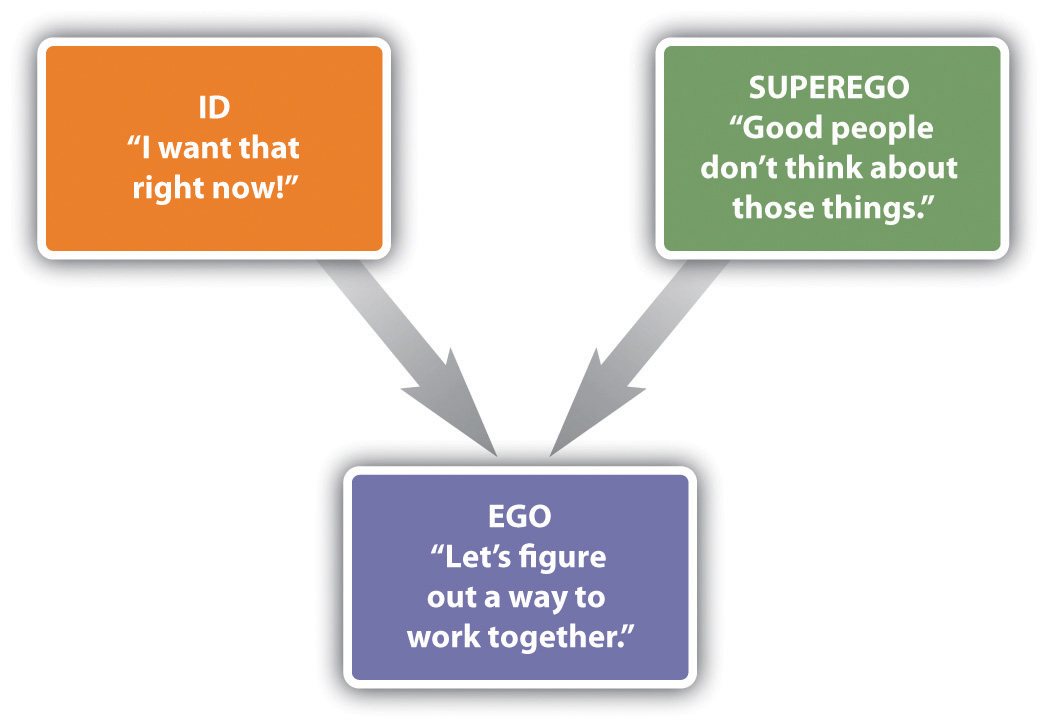
  • Freud proposed that the mind is divided into three components: idego, and superego, and that the interactions and conflicts among the components create personality


The id is the component of personality that forms the basis of our most primitive impulses

  • The id is entirely unconscious, and it drives our most important motivations, including the sexual drive (libido) and the aggressive or destructive drive 
  • According to Freud, the id is driven by the pleasure principle — the desire for immediate gratification of our base instinct urges. 
  • The id is why we smoke cigarettes, drink alcohol,, tell mean jokes about people, and engage in other fun or harmful behaviors, often at the cost of doing more productive activities.

The superego represents our sense of morality and ethics

  • The superego tell us all the things that we shouldn’t do, or the duties and obligations of society. The superego strives for perfection, and when we fail to live up to its demands we feel guilty.  

The ego is the largely conscious controller or decision-maker of personality

  • The ego serves as the intermediary between the desires of the id and the constraints of society contained in the superego.  
  • The ego is based on the reality principle — the idea that we must delay gratification of our basic motivations until the appropriate time with the appropriate outlet. 


Defense mechanisms — unconscious psychological strategies used to cope with anxiety and maintain a positive self-image. Freud believed that the defence mechanisms were essential for effective coping with everyday life, but that any of them could be overused


Activity #2 - "Do drugs feed the id or ease the anxiety?" 

Carefully read the article linked below regarding addiction and psychodynamic theory.  Once you have finished, answer the following questions on a separate sheet of paper to turn in before you leave.

1.  How does the author explain addiction through psychodynamic theory?  Do you agree?  Why or why not?

2.  What questions would you ask the author about his article if he were here? 

3.  Based on the article, to what extent do some people's personalities leave them more likely to use drugs?

https://www.psychologytoday.com/us/blog/science-choice/201410/psychodynamic-way-understanding-addiction

Close - Post at least 2 questions here:

https://docs.google.com/spreadsheets/d/1iKDtCmP_Q4AHlAjd2APb2qjx2U2xTSgqM71Hmvl9KK4/edit?usp=sharing

MAKE SURE THAT YOU CLICK THE APPROPRIATE TAB AT THE BOTTOM OF THE PAGE

Thursday, March 28, 2019

Day 22 - Personality - Reflection

Learning Targets - Students will be able to 
  • Analyze the trait approach and how it identifies a person’s most striking personality characteristics 
Opener - Finding your new BFF...maybe

  • Open your notebooks to "Activity 2" from last class (reflection questions following the personality test that you took).  
  • Next, find a classmate that shares the first two letters of the personality code that you received at the end of the quiz (i.e. ESTJ).  

Activity #1 - Sharing your reflections

With your newly found BFF, compare your responses to the questions that you answered below:

  1.  How accurate would you rate this test in describing how you see yourself (1-10 with 10 being most accurate)?  BRIEFLY EXPLAIN.
  2. Explain why knowing your personality type might be useful?
  3. Do you think that you could ever accurately take this test for someone else?  Why or why not?
  4. To what degree can self-administered test ever be accurate or trustworthy?  Why might the test taker be less than honest when taking the test?


Activity #2 - "Who are you really?" 


After viewing the video above, address each of the following:

1.  What is the most valuable idea or concept discussed in the video?
2.  How might this information be useful for most people?
3.  Identify one point in which you would question or disagree with the speaker.


Close - Post at least 2 questions here:

https://docs.google.com/spreadsheets/d/1iKDtCmP_Q4AHlAjd2APb2qjx2U2xTSgqM71Hmvl9KK4/edit?usp=sharing

MAKE SURE THAT YOU CLICK THE APPROPRIATE TAB AT THE BOTTOM OF THE PAGE
Days 37  - Psychological Disorders - A Beautiful Mind Learning Targets  -  Students will be able to  Describe and analyze common symp...