Day 6 - Not all learned behaviors are good behaviors
Learning Targets - Students will be able to...
Compare and contrast the various theories of learning: classical, operant and observational (Pavlov, Watson, Skinner, Bandura)
Describe the reinforcement schedules and identify primary vs. secondary reinforcers
Distinguish between negative reinforcement and punishment
Opener- Quickwrite
How is criminal behavior often reinforced?
Activity #1 - Learning, society and the criminal justice system - Mini Lecture Deterrence - Discouraging behavior through the fear of perceived consequences. Incarceration - The removal of an individual from society temporarily following the demonstration of undesirable behavior. Rehabilitation - The action of restoring someone to health or normal life through training and therapy after imprisonment, addiction, or illness. Retribution/Recompense - Focus on punishing the criminal behavior in a manner that also serves to compensate the victim/society.
Activity #2 -Reforming behavior in the "adult world"
Examine the 4 approaches to reforming criminal behavior introduced above and outline the following:
1. What principle(s) or theories of psychology does each represent?
2. What would be necessary for each approach to be successful in reducing criminal behavior?
3. What would be the greatest challenge in adopting this system?
Compare and contrast the various theories of learning: classical, operant and observational (Pavlov, Watson, Skinner, Bandura)
Describe the reinforcement schedules and identify primary vs. secondary reinforcers
Distinguish between negative reinforcement and punishment
Opener- As we know from last semester, for someone to be hypnotized, they must first WANT to be hypnotized. To what degree might this be true when it comes to learning and WANTING to learn?
Activity #1 - The passage below comes from a recently published Canadian textbook. Read through this passage and then respond to the following questions/prompts: 1. What are the limits of positive reinforcement in the classroom? Describe at least 3. 2. How does a student's expectation of rewards alter how effective the reward is in reinforcing desirable behavior? 3. What happens if the student knows that they are being "trained" by the teacher?
Psychology in Everyday Life: Operant Conditioning in the Classroom
John B. Watson and B. F. Skinner believed that all learning was the result of reinforcement, and thus that reinforcement could be used to educate children. For instance, Watson wrote in his book on behaviourism,
Give me a dozen healthy infants, well-formed, and my own specified world to bring them up in and I’ll guarantee to take any one at random and train him to become any type of specialist I might select — doctor, lawyer, artist, merchant-chief and, yes, even beggar-man and thief, regardless of his talents, penchants, tendencies, abilities, vocations, and race of his ancestors. I am going beyond my facts and I admit it, but so have the advocates of the contrary and they have been doing it for many thousands of years (Watson, 1930, p. 82).
Skinner promoted the use of programmed instruction, an educational tool that consists of self-teaching with the aid of a specialized textbook or teaching machine that presents material in a logical sequence (Skinner, 1965). Programmed instruction allows students to progress through a unit of study at their own rate, checking their own answers and advancing only after answering correctly. Programmed instruction is used today in many classes — for instance, to teach computer programming (Emurian, 2009).
Although reinforcement can be effective in education, and teachers make use of it by awarding gold stars, good grades, and praise, there are also substantial limitations to using reward to improve learning. To be most effective, rewards must be contingent on appropriate behaviour. In some cases teachers may distribute rewards indiscriminately — for instance, by giving praise or good grades to children whose work does not warrant it — in the hope that students will “feel good about themselves” and that this self-esteem will lead to better performance. Studies indicate, however, that high self-esteem alone does not improve academic performance (Baumeister, Campbell, Krueger, & Vohs, 2003). When rewards are not earned, they become meaningless and no longer provide motivation for improvement.
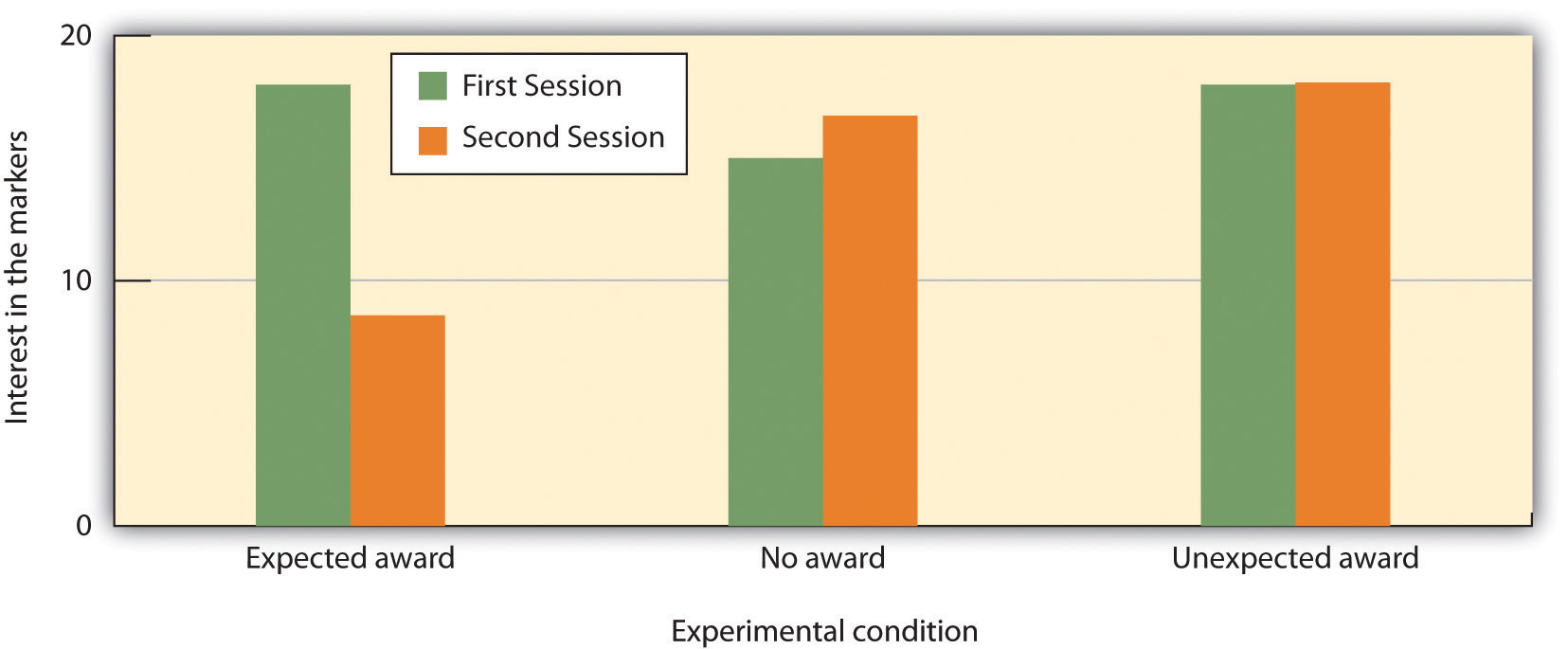
Another potential limitation of rewards is that they may teach children that the activity should be performed for the reward, rather than for one’s own interest in the task. If rewards are offered too often, the task itself becomes less appealing. Mark Lepper and his colleagues (Lepper, Greene, & Nisbett, 1973) studied this possibility by leading some children to think that they engaged in an activity for a reward, rather than because they simply enjoyed it. First, they placed some fun felt-tipped markers in the classroom of the children they were studying. The children loved the markers and played with them right away. Then the markers were taken out of the classroom, and the children were given a chance to play with the markers individually at an experimental session with the researcher. At the research session, the children were randomly assigned to one of three experimental groups. One group of children (the expected reward condition) was told that if they played with the markers they would receive a good drawing award. A second group (the unexpected reward condition) also played with the markers, and also got the award — but they were not told ahead of time that they would be receiving the award; it came as a surprise after the session. The third group (the no reward group) played with the markers too, but got no award.
Then the researchers placed the markers back in the classroom and observed how much the children in each of the three groups played with them. As you can see in Figure 8.9, “Undermining Intrinsic Interest,” the children who had been led to expect a reward for playing with the markers during the experimental session played with the markers less at the second session than they had at the first session. The idea is that, when the children had to choose whether or not to play with the markers when the markers reappeared in the classroom, they based their decision on their own prior behaviour. The children in the no reward group and the children in the unexpected reward group realized that they played with the markers because they liked them. Children in the expected award condition, however, remembered that they were promised a reward for the activity the last time they played with the markers. These children, then, were more likely to draw the inference that they play with the markers only for the external reward, and because they did not expect to get an award for playing with the markers in the classroom, they determined that they didn’t like them. Expecting to receive the award at the session had undermined their initial interest in the markers.
Figure 8.9 Undermining Intrinsic Interest. Mark Lepper and his colleagues (1973) found that giving rewards for playing with markers, which the children naturally enjoyed, could reduce their interest in the activity. [Long Description]
This research suggests that, although receiving a reward may in many cases lead us to perform an activity more frequently or with more effort, a reward may not always increase our liking for the activity. In some cases a reward may actually make us like an activity less than we did before we were rewarded for it. This outcome is particularly likely when the reward is perceived as an obvious attempt on the part of others to get us to do something. When children are given money by their parents to get good grades in school, they may improve their school performance to gain the reward. But at the same time their liking for school may decrease. On the other hand, rewards that are seen as more internal to the activity, such as rewards that praise us, remind us of our achievements in the domain, and make us feel good about ourselves as a result of our accomplishments, are more likely to be effective in increasing not only the performance of, but also the liking of, the activity (Hulleman, Durik, Schweigert, & Harackiewicz, 2008; Ryan & Deci, 2002).Other research findings also support the general principle that punishment is generally less effective than reinforcement in changing behaviour. In a recent meta-analysis, Gershoff (2002) found that although children who were spanked by their parents were more likely to immediately comply with the parents’ demands, they were also more aggressive, showed less ability to control aggression, and had poorer mental health in the long term than children who were not spanked. The problem seems to be that children who are punished for bad behaviour are likely to change their behaviour only to avoid the punishment, rather than by internalizing the norms of being good for its own sake. Punishment also tends to generate anger, defiance, and a desire for revenge. Moreover, punishment models the use of aggression and ruptures the important relationship between the teacher and the learner (Kohn, 1993).
- The above passage is courtesy of www.opentextbc.ca
Activity #2 -Reforming behavior in the "adult world"
One of the most important discussions that a society can have is about how we reform the behavior of those citizens that choose not to follow the law. Drawing upon what you have learned about conditioning and learning, and using the appropriate vocabulary, answer the following:
1. Describe the methods employed in the US criminal justice system here in the United States.
2. What other options do we have in reforming criminal behavior?
3. What would B.F. Skinner likely suggest?
Day 3 - Operant Conditioning - Anything can be learned!
Learning Targets - Students will be able to compare and contrast the various theories of learning: classical, operant and observational (Pavlov, Watson, Skinner, Bandura)
Opener- Is there anything that can't be taught/learned? Like what? Explain.
Activity #1 - Conditioning and Schedules Continuous reinforcement schedule, in which the desired response is reinforced every time it occurs
Whenever the dog rolls over, for instance, it gets a biscuit. Continuous reinforcement results in relatively fast learning but also rapid extinction of the desired behavior once the reinforcer disappears.
Most real-world reinforcers are not continuous; they occur on a partial (or intermittent) reinforcement schedule — a schedule in which the responses are sometimes reinforced and sometimes not.
In comparison to continuous reinforcement, partial reinforcement schedules lead to slower initial learning, but they also lead to greater resistance to extinction.
(Tables downloaded from opentextbc.ca) Behaviors can also be trained through the use of secondary reinforcers. A primary reinforcer includes stimuli that are naturally preferred or enjoyed by the organism, such as food, water, and relief from pain, a secondary reinforcer (sometimes called conditioned reinforcer) is a neutral event that has become associated with a primary reinforcer through classical conditioning.
Example - a secondary reinforcer would be the whistle given by an animal trainer, which has been associated over time with the primary reinforcer, food.
An example of an everyday secondary reinforcer is money. We enjoy having money, not so much for the stimulus itself, but rather for the primary reinforcers (the things that money can buy) with which it is associated.
Activity #2 - Operant Conditioning Scenarios
The chart above provides a number of examples of operant conditioning. What method(s) would YOU use to teach each of the skills or habits below? Be sure to label and describe US, UR, CS, CR for each.
Remembering to turn off the lights before you leave the room.
Learning how to swim the butterfly stroke.
Memorizing formulas for an upcoming chemistry test.
Creating and recording questions everyday in your psychology notebook.
BE SURE THAT BOTH OF YOU RECORD YOUR RESPONSES IN YOUR NOTEBOOK
Close - 1-2 questions recorded in your notebook regarding conditioning, reinforcers, punishment, etc
Thursday, December 13, 2018
Day 38
Learning Targets:
Students will be able to describe the structure and function of the 5 basic senses and how these processes influence human behavior.
Students will be able to understand the impact of perception on the influence of behavior.
Opener: If you were to lose your sense of taste and/or smell, what potential dangers might you find yourself in? In what situations might this absence of sensation afford you some sort of advantage over those around you?
Activity #1:Most of our cerebral cortex is devoted to seeing, and we have substantial visual skills. The eye is a specialized system that includes the cornea, pupil, iris, lens, and retina. But what if there was no visual information for our sensory cortex to process? Would it do a better job processing our other senses?
As you can see from the video above, John has more than compensated for his loss of vision when it comes to painting. Answer the questions below in order to explain how this enhanced artistic ability came to be.
1. Which senses have become more critical to John as he creates his portraits?
2. How might John employ his other senses to accomplish other day-to-day tasks? Explain using all appropriate terminology from this unit.
3. Describe two situations where depriving ourselves the use of one of our senses could actually enhance our ability to perform a specific task.
Activity #2:
1. What senses would be most critical for Ashland to avoid injury and accidents given her lack of pain sensation?
2. What other implications, aside from the potential for physical injury, might there be for Ashland?
3. Evaluate John and Ashland's absence of sensations and describe the similar and different ways in which they have adapted to these conditions.
Students will be able to describe the structure and function of the 5 basic senses and how these processes influence human behavior.
Students will be able to understand the impact of perception on the influence of behavior.
Opener: Which of the following professions do you believe are most reliant on their senses and perceptions in order to be successful in their careers? Explain. ER Doctor Heavy Equipment Operator Car Salesman
Software Engineer
Interior Decorator
Activity #1:Sensation and perception work seamlessly together to allow us to detect both the presence of, and changes in, the stimuli around us. Read each of the scenarios below and answer the corresponding questions. Be sure to include as many of the key terms and concepts listed below in your responses.
Scenario #1 - Protection
You have decided to pursue a career in public service and have ended up in the Secret Service as part of the President's security detail. While giving a speech during a campaign rally for the upcoming election, you have been notified of a potential threat from within the crowd.
1. Which senses are going to be the most critical in keeping the president safe?
2. What have we learned about the sensation and perception that will allow you to more effectively do your job?
3. Which of the following sensation/perception concepts or effects would be important for someone in your position to teach new agents that are joining your team?
Activity #2:
Scenario #2 - Restaurant Critic
Given your extraordinarily sharp senses, coupled with a flare for descriptive writing, you have been hired by Zagats to review local restaurants in Kansas City. You've eagerly set out on your adventure and really want to do a good job on your first assignment. You've decided to start your new career by reviewing your favorite restaurant in KC. Suddenly you remember just how important it is to be aware of your senses and perceptions when you enter the restaurant.
1. What senses, aside from taste, do you need to pay attention to upon entering the restaurant? How does this influence what you will taste?
2. What advice would you give your readers about how to make their dining experience more enjoyable?
3. What advice would you give the owner/manager of the restaurant to make in order to influence their customers sense of taste?
Students will be able to describe the structure and function of the 5 basic senses and how these processes influence human behavior.
Students will be able to understand the impact of perception on the influence of behavior.
Opener: How do we know where exactly our hands, feet, or any other part of the body are when we can't see it? For example, if you were in a pitch black room, wouldn't you still know which foot is in front of the other? Couldn't you still clap your hands together?
Activity #1:The Skin Senses - Mini - Lecture
The skin, the largest organ in the body, is the sensory organ for touch. The skin contains a variety of nerve endings, combinations of which respond to particular types of pressures and temperatures.
The thousands of nerve endings in the skin respond to four basic sensations — pressure, hot, cold, and pain — but only the sensation of pressure has its own specialized receptors.
Other sensations are created by a combination of the other four. For instance:
The experience of a tickle is caused by the stimulation of neighbouring pressure receptors.
The experience of heat is caused by the stimulation of hot and cold receptors.
The experience of itching is caused by repeated stimulation of pain receptors.
The experience of wetness is caused by repeated stimulation of cold and pressure receptors.
Proprioception — the ability to sense the position and movement of our body parts. Proprioception is accomplished by specialized neurons located in the skin, joints, bones, ears, and tendons, which send messages about the compression and the contraction of muscles throughout the body
The ability to keep track of where the body is moving is also provided by the vestibular system,a set of liquid-filled areas in the inner ear that monitors the head’s position and movement, maintaining the body’s balance.
The Vestibular System. The vestibular system includes the semicircular canals (brown) that transduce the rotational movements of the body, and the vestibular sacs (blue) that sense linear accelerations.
We do not enjoy it, but the experience of pain is how the body informs us that we are in danger. The burn when we touch a hot radiator and the sharp stab when we step on a nail lead us to change our behavior, preventing further damage to our bodies.
The gate control theory of pain;">proposes that pain is determined by the operation of two types of nerve fibers in the spinal cord
. One set of smaller nerve fibers carries pain from the body to the brain, whereas a second set of larger fibers is designed to stop or start (as a gate would) the flow of pain (Melzack & Wall, 1996). It is for this reason that massaging an area where you feel pain may help alleviate it — the massage activates the large nerve fibers that block the pain signals of the small nerve fibers (Wall, 2000).
Just like other senses, we are less aware of pain when we are focused on other stimuli around us.
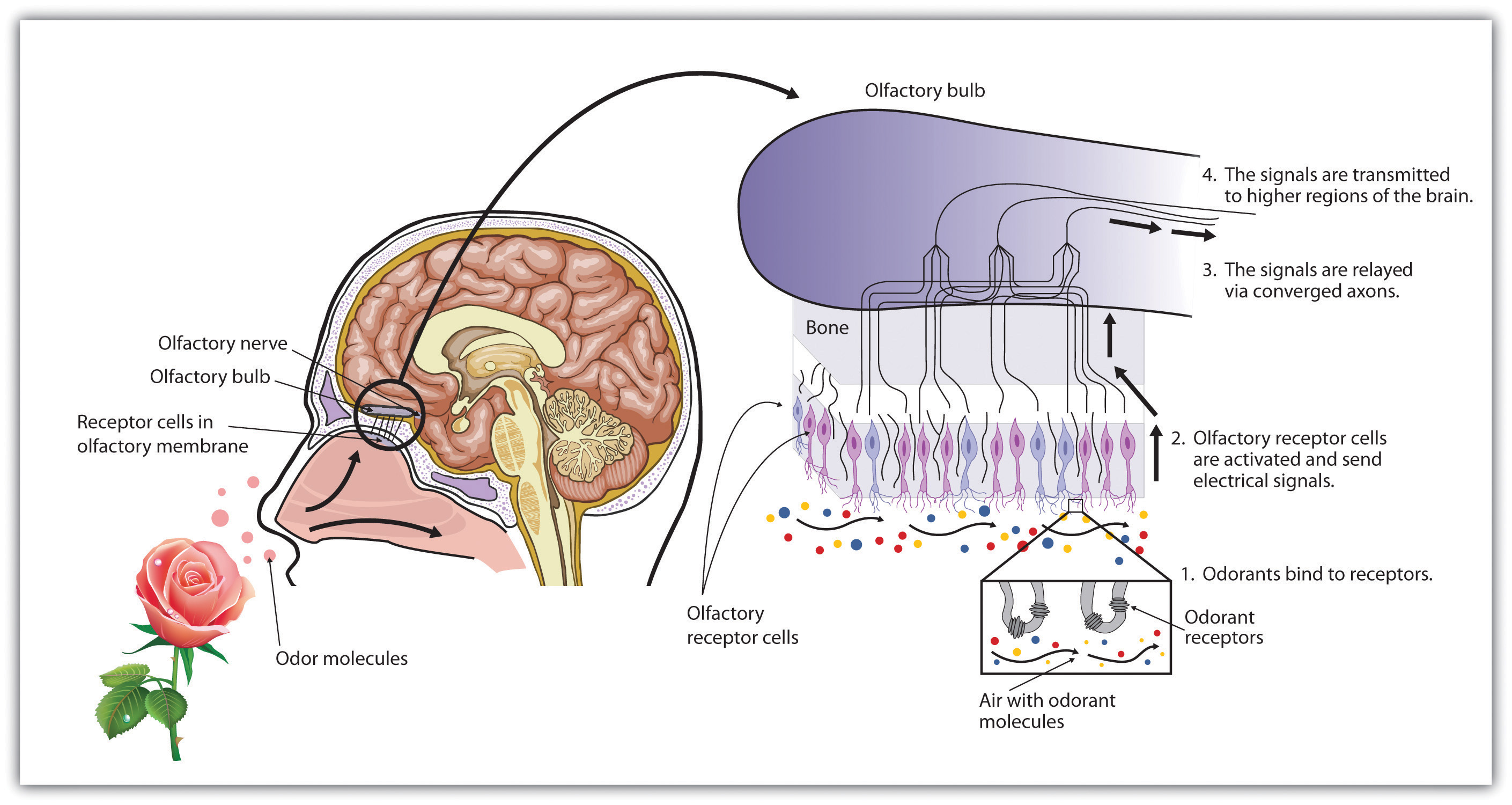
As we breathe in air through our nostrils, we inhale airborne chemical molecules, which are detected by the 10 million to 20 million receptor cells embedded in the olfactory membraneof the upper nasal passage.
When an odor receptor is stimulated, the membrane sends neural messages up the olfactory nerve to the brain.
Smell Receptors. There are more than 1,000 types of odor receptor cells in the olfactory membrane.
We have approximately 1,000 types of odor receptor cells , and it is estimated that we can detect 10,000 different odors.
Different chemical molecules fit into different receptor cells, and odors are detected according to their influence on a combination of receptor cells.
Just as the 10 digits from 0 to 9 can combine in many different ways to produce an endless array of phone numbers, odor molecules bind to different combinations of receptors, and these combinations are decoded in the olfactory cortex.